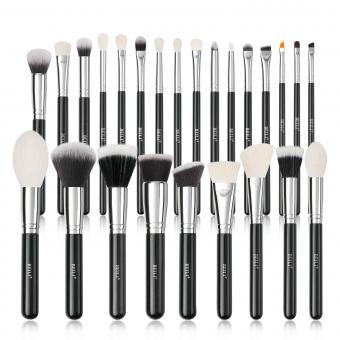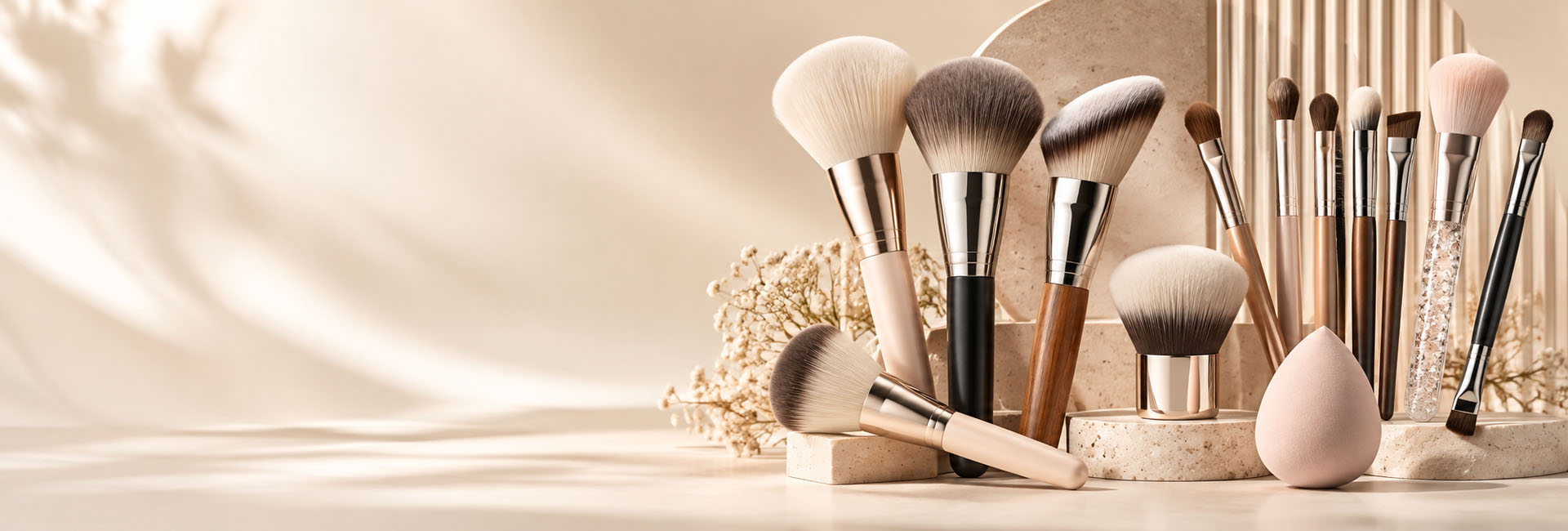
For beauty brands, startups, distributors, and private label companies, one of the first questions when developing a custom makeup brush is simple:
How much will it cost?
The answer depends on much more than the brush itself. Bristle material, brush size, handle material, ferrule finish, logo application, packaging, order quantity, and customization requirements can all influence the final cost.
Understanding these factors before requesting a quotation can help you select the right specifications, control your budget, and avoid unexpected costs during product development.
In this guide, we explain the main factors that affect the cost of custom makeup brushes and how beauty brands can make better sourcing decisions.
A custom makeup brush usually consists of several major components:
Brush bristles
Ferrule
Handle
Logo or decoration
Packaging
Assembly
Quality control
Shipping
Each component can be customized, and each customization can affect the final unit price.
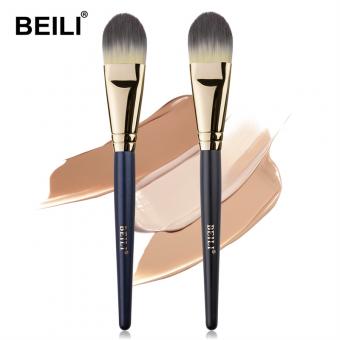
For example, a basic synthetic foundation brush with a standard handle may have a very different cost from a premium private label brush with a custom bamboo handle, metallic ferrule, custom logo, and luxury packaging.
This is why two products that look similar in photographs can receive very different factory quotations.
The bristle is one of the most important factors affecting both brush performance and product positioning.
Synthetic fibers are widely used for modern makeup brushes because they offer consistent quality, easy cleaning, and vegan-friendly options.
Different synthetic fibers can have different softness, density, elasticity, and product pickup characteristics.
For brands targeting the vegan or cruelty-free beauty market, premium synthetic fibers are often an attractive choice.
Natural hair such as goat hair can provide a distinctive texture and excellent powder application performance.
However, natural hair specifications can vary significantly in softness, grade, length, and processing, which means the material choice can have a meaningful impact on product cost.
Some professional makeup brushes use specialized fibers designed for specific applications, such as foundation, concealer, blending, or detailed eye makeup.
When developing a premium product line, the goal should not simply be choosing the cheapest fiber. The better approach is to select a fiber that matches the intended application and target price range.
The handle is another major part of the product specification.
Common options include:
Wood
Bamboo
Plastic
Acrylic
Aluminum
Wood handles are popular for professional and premium makeup brush collections because they offer a classic appearance and can be customized with different colors and finishes.
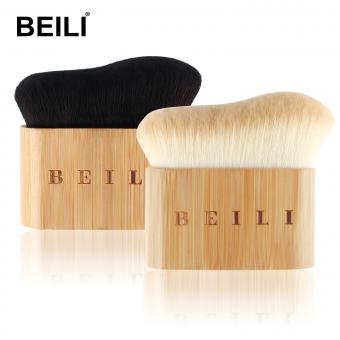
Bamboo is especially suitable for brands that want to communicate a natural or eco-conscious brand image.
For private label products, bamboo can also create a distinctive visual identity compared with standard plastic handles.
Aluminum handles can create a modern, premium appearance and are suitable for brands looking for a contemporary aesthetic.
The material, thickness, shape, finishing process, and surface treatment can all affect the final cost.
The ferrule connects the brush head to the handle, but it also plays an important role in the appearance of the finished product.
Common options include aluminum and other metal finishes.
Brands can often customize:
Ferrule color
Surface finish
Shape
Thickness
Plating or coating
For example, matte black, silver, gold, and rose gold finishes can create very different visual effects.
A luxury brush collection may require a more sophisticated ferrule finish than a standard mass-market product.
Private label buyers often want their brand logo applied to the handle.
Common decoration methods include:
Silk screen printing
Pad printing
Laser engraving
Hot stamping
The best method depends on the handle material, logo design, number of colors, and desired appearance.
For a simple one-color logo, the decoration process may be relatively straightforward.
For a premium collection, a brand may choose metallic hot stamping or laser engraving to create a more distinctive appearance.
The brush is only part of the finished retail product.
Packaging options may include:
Paper boxes
Rigid gift boxes
Magnetic boxes
Brush rolls
PU leather bags
Cosmetic bags
Custom printed cartons
A startup selling brushes through an online store may choose simple recyclable paper packaging to control costs.
A luxury beauty brand may prefer a rigid magnetic box with custom printing and an interior tray.
Therefore, packaging should be considered together with the target retail positioning rather than treated as an afterthought.
Order quantity is another important factor in custom makeup brush manufacturing.
In general, larger production quantities can allow manufacturers to spread tooling, setup, printing, packaging, and other production costs across more units.
For example, a small startup may begin with a limited production quantity to test the market, while an established cosmetics company may place a much larger repeat order after validating customer demand.
For this reason, when requesting a quotation, buyers should provide an estimated order quantity rather than asking only for a single unit price.
A manufacturer can then provide a more useful quotation based on the actual project.
Not every private label project needs to start from a completely new brush design.
There are generally two approaches.
The manufacturer already has an existing brush design.
The brand customizes:
Logo
Handle color
Ferrule color
Packaging
This approach can reduce product development complexity and may be suitable for startups launching their first collection.
The brand creates a new brush specification involving:
Custom brush shape
Custom bristle specification
Custom handle
Custom ferrule
Custom logo
Custom packaging
This approach provides much greater differentiation but usually requires more product development work.
For established brands, fully customized development can be worthwhile when the goal is to create an exclusive product line.
When comparing makeup brush manufacturers, it is easy to focus only on the unit price.
However, a lower quotation may involve differences in:
Bristle density
Fiber quality
Handle material
Ferrule thickness
Glue performance
Logo durability
Packaging quality
Quality control
Production consistency
For a beauty brand, a small reduction in manufacturing cost may not be worthwhile if it results in inconsistent brush performance or quality complaints from customers.
The better approach is to compare the complete product specification, not only the quoted price.
The more specific your requirements are, the easier it is for a manufacturer to provide a useful quotation.
Before contacting a supplier, prepare the following information:
Product Type
Foundation brush, concealer brush, blush brush, eyeshadow brush, eyebrow brush, makeup brush set, etc.
Bristle Material
Synthetic, vegan fiber, goat hair, or another specification.
Handle Material
Wood, bamboo, plastic, aluminum, or another material.
Ferrule
Material, color, finish, and shape.
Logo
Printing, laser engraving, hot stamping, or another method.
Packaging
Individual box, set box, brush pouch, cosmetic bag, or custom retail packaging.
Order Quantity
Estimated quantity for the first order and potential repeat orders.
Target Market
For example, the US, Europe, Middle East, or another market.
With this information, a manufacturer can usually provide a much more meaningful quotation and development recommendation.
There are several practical ways to manage your budget without sacrificing the core quality of the product.
Instead of customizing every component immediately, prioritize the elements that customers will notice most:
Brush performance
Handle appearance
Brand logo
Packaging
A more expensive fiber is not automatically better for every brush.
The best material depends on whether the brush is designed for liquid foundation, powder, blush, eyeshadow, contour, concealer, or detailed application.
For startups, using an existing professional brush design with custom branding can reduce product development complexity.
Once the product line demonstrates market demand, the brand can move toward fully customized designs.
Packaging should match the retail positioning.
Premium packaging can increase perceived value, but unnecessary packaging components can also increase costs and shipping volume.
Before placing a bulk order, brands should usually evaluate samples.
A sample allows you to check:
Bristle softness
Density
Shape
Product pickup
Handle quality
Ferrule connection
Logo quality
Packaging appearance
Sample development may involve different costs depending on how much customization is required.
However, investing in samples before bulk production can reduce the risk of receiving a large quantity of products that do not meet your expectations.
Price is only one part of supplier selection.
For a long-term private label project, buyers should also evaluate:
Customization Capability
Can the manufacturer customize bristles, handles, ferrules, logos, and packaging?
Quality Control
Does the supplier have a clear inspection process?
Product Development
Can the manufacturer help improve the brush specification?
Communication
Can the supplier respond clearly and quickly during sampling and production?
Production Capacity
Can the factory support larger repeat orders if the product becomes successful?
Packaging Support
Can one supplier provide both brushes and packaging?
A manufacturer that can support the complete development process may provide more value than a supplier offering the lowest initial unit price.
The cost of custom makeup brushes depends on the complete product specification rather than one single factor.
Bristle material, handle material, ferrule finish, logo customization, packaging, order quantity, and development requirements all influence the final quotation.
For beauty startups, private label brands, wholesalers, and established cosmetics companies, the most effective approach is to define the target market and product positioning first, then select materials and customization options that match the desired price range.
At BEILI, we provide custom makeup brush solutions for beauty brands, wholesalers, and private label businesses, including brush customization, logo application, packaging, and OEM/ODM production.
Whether you are developing your first makeup brush collection or expanding an existing beauty brand, a clear product specification is the first step toward an accurate quotation and a successful product launch.
Ready to develop your own makeup brushes? Contact BEILI to discuss your project and request a customized quotation.
1102, Hefei Software Park Luyang Incubation Park, Luyang District, Hefei City, Anhui Province
telefono : +86 13355501971
Whatsapp : +86 13355501971
E-mail : jenny@beilimakeup.com


Link amichevoli :
Dingsheng Cosmetics Packaging Rete IPv6 supportata